
The NI Annex B
DP Simulator Course
Charlie C. Stuart
Instructor

The Nautical Institute
Annex B
DP Simulator Course
February 2025 – Version 1
Disclaimer
While every effort has been made to ensure that all the information in this document is updated and correct, The Nautical Institute cannot be held responsible for any loss, financial or otherwise, direct or indirect, resulting from use of this information. Likewise, The Nautical Institute cannot be held responsible for any damage to property or personnel while following these guidelines. This information is produced in good faith, but The Nautical Institute cannot guarantee the accuracy and/or completeness of the information, which is produced for guidance purposes only.
© The Nautical Institute 2025
200B Lambeth Road, London, SE1 7JY United Kingdom Tel: +44 (0)20 7928 1351
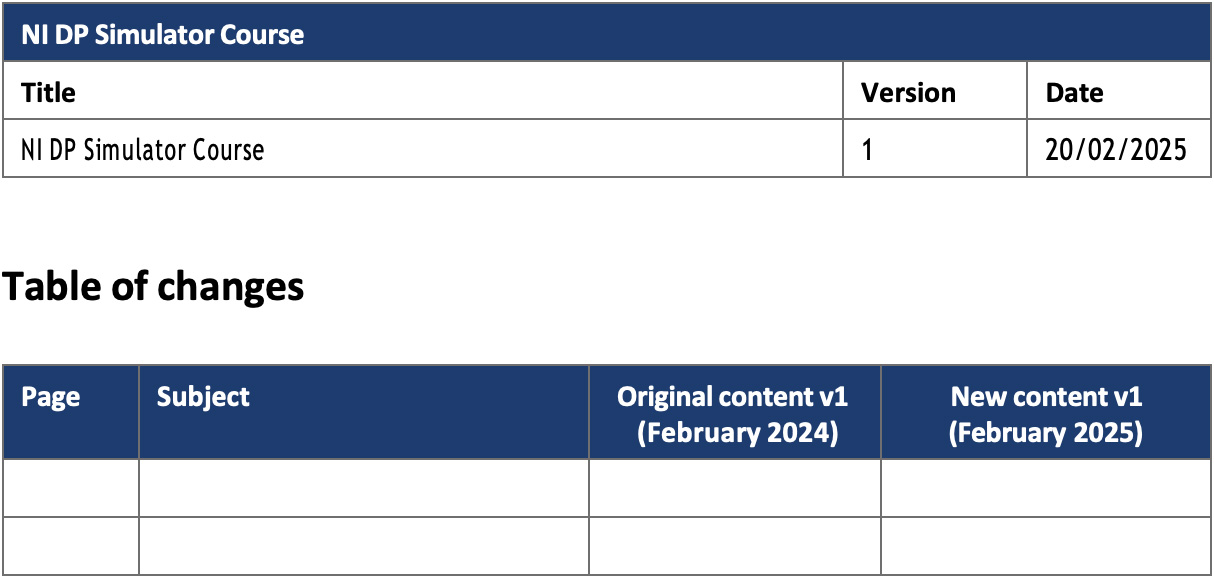
Document version control
1. Introduction
DP Simulator Course has a three-part assessment process:
- DP Set-Up Practical Assessment, undertaken as the course This must be successfully completed and competence to perform tasks is a requirement to pass the course.
- Online Exam at completion of course which needs to be
- Formative Assessment, which is feedback given to students throughout the This may vary from centre to centre but should consist of:
- briefing, consisting of Scenario Objects (SMART) and feedback criteria (how to measure a participant’s obtaining a correct level)
- debriefing, consisting of two parts, feedback from students and feedback from the instructor, specifically after simulator exercises.
The debriefing note from the instructor must be retained for a period of at least three years.
2. Minimum Entry Qualification Requirements
The course is a key element of the DPO training programme. As such, participants will have completed the Induction Course and gained the specified experience before enrolment.
3. Number of Hours
A minimum of 28 hours teaching time is required for this course; if additional time is required to deal with paperwork or administer exams this time shall be added to the 28 hours. It is suggested that a split of 30% of the course time is spent on theory and 70% on practical exercises (including the time spent on briefing and debriefing).
4. Ratio of Students/Instructors/Equipment
The number of students attending the Simulator Course must be regulated so that each student obtains sufficient hands-on experience of operating the system when having to react to various failure scenarios. In order to achieve this, The NI allows a maximum ratio of four students taught by one instructor per one Class B or A Simulator.
By exception, and where justified, a ratio of five or six students may be considered at the discretion of The NI’s Accreditation Team, based on the number of simulators in place, rotation of students and the use of the training methodology in place.
When two simulator systems are available in a training centre, “best practice” is to keep each trainee on the same simulator throughout the Simulator Course.
5. Delivery Method
The training will be predominantly practical/operational in nature. Exercises and case studies will be carried out in a facility that meets the provisions set out in the document NI DP Simulator specification (Annex 5 of the Accreditation and Certification Standard Volume 2).
In addition to exercise briefing/debriefing, students will be given an opportunity to give feedback on their training needs during classroom tuition.
This course is intended for those who have completed the Induction Course and a minimum of 60 DP sea time days. These students should already have a good grounding in the practice and principles of dynamic positioning through their experiences in class and at sea.
The DP Simulator Course is intended to build on that experience and to provide realistic DP-based scenario work. These scenarios should provide the opportunity to practice all aspects of the planning and conduct of typical DP operations, including the handling of emergencies. Particular emphasis should be placed upon teamwork within the role-play scenarios.
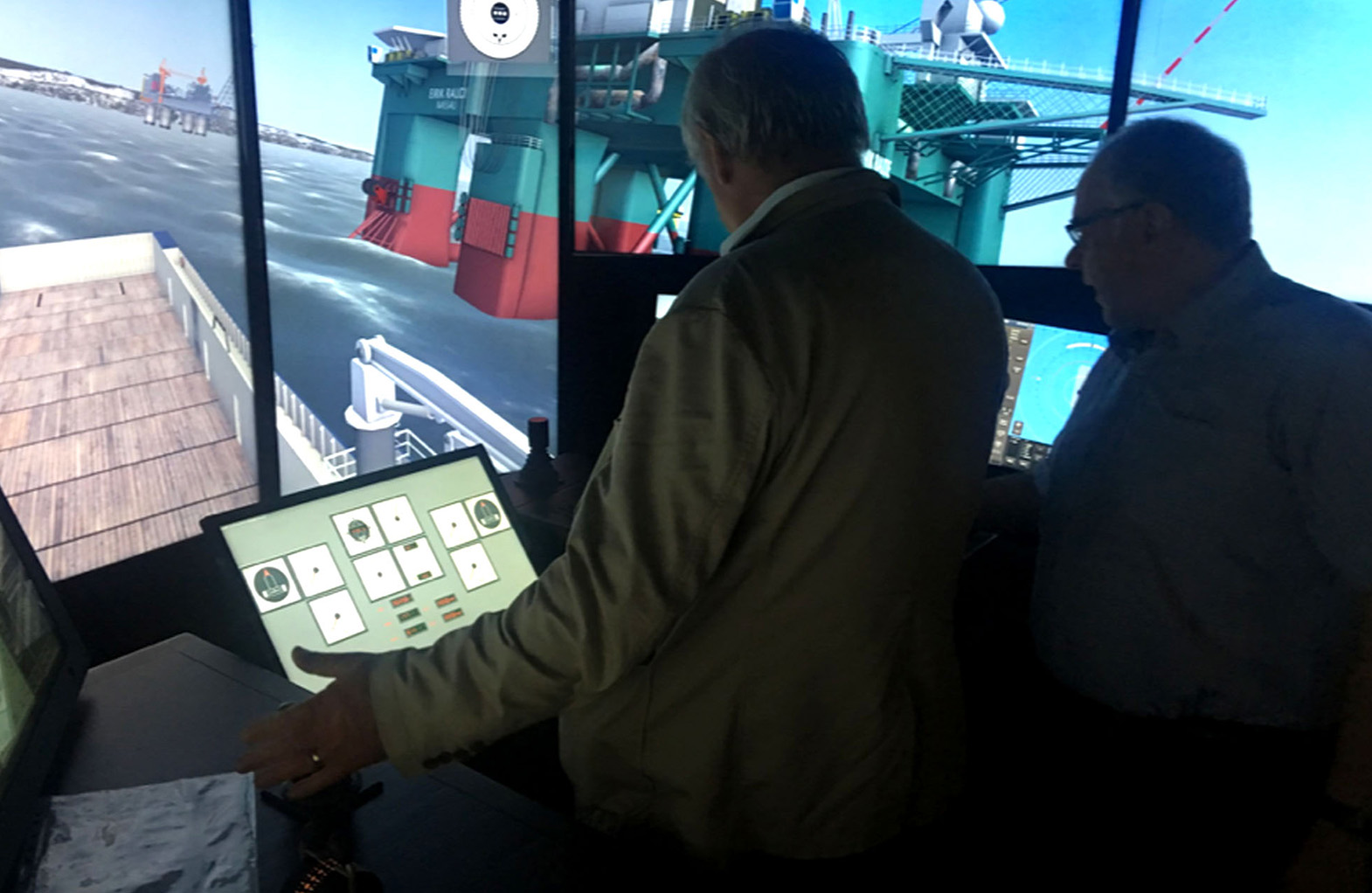
A typical installation will consist of a redundant DP system interfaced with a simulator system coordinated by the instructor’s input. Other facilities will include a realistic communications suite, suitable chartroom facilities and support documentation.
DP scenarios must closely match the situation onboard a vessel. Communications form an important part of any DP situation, so they must be adequately simulated in any training facility, with several different means of communication between the instructor station and the DPO/ trainee facility. Communications to be simulated include:
VHF on emergency and working channels. A useful addition is a listing of the various channels monitored by the various installations and vessels taking part in the simulations.
Talk-back to areas such as ROV control, dive control.
Telephone to areas such as the MCR.
DP status alarms (red, amber, blue/white and green traffic lights).
DP status board. This facility may form part of a planned crisis; the instructor may mark up the status board incorrectly at the beginning of a scenario to discover if the trainees are completing their checklists meticulously.
The training establishment must provide materials to support the hardware simulator facility. This will mainly consist of relevant documentation which will include:
Plans and drawings showing the oilfield or operating area used in the simulations.
Drawings of the various installations within the operating areas, together with any specifications or other necessary details.
Drawings and data sheets relating to the vessel or vessels under simulation; these drawings to include DP capability plots.
Operational instructions, checklists and standing orders associated with the vessel or vessels.
A set of scenario information sheets. Each scenario should be designed to provide at least one specific, planned crisis or problem for the trainees to react to. Other problem areas should be kept in hand for use in the event of the trainees coping with the primary planned crisis in short order.
Training centres must ensure all sources of time keeping are aligned and synchronised. Especially for the recording of time during DP Simulator based exercises.
6. Course Aims
On completion of the Simulator Course the student should be able to:
- Carry out operational planning, risk assessment and hazard identification
- Set up the DP system for a particular
- Operate the
- Analyse the
- Discuss systems
- Decide on courses of action because of systems
- React to alarms and printer
- Initiate DP alert status
- React to all events
- Operate the desk under normal and pressured
- Practice effective
- Apply the lessons learned to
- Act in line with the appropriate Area-Specific Operating Guide (ASOG)
7. Course Objectives
Operation and DP System
7.1
Demonstrate ability through participation in exercises to set up, operate and carry out manoeuvres using the DP system under the following control modes:

7.2
Demonstrate ability through group exercises to set up, operate and carry out manoeuvres using the DP system under the following control modes:

7.3
Demonstrate within the DP Simulator the operation of position reference systems, sensors and peripheral equipment associated with the DP system.
7.4
Understand the operation of heading modes where the DP system continuously determines and automatically sets vessel heading to minimise power/thrust requirements.
DP Operation
7.5
Interpret vessel plans and specifications.
- Interpret information found on paper or electronic field charts relevant to the planning and conduct of DP operations.
7.6
Using vessel and other data such as capability plots (paper or electronic), footprint plots to assess the capability of the vessel to complete successfully any proposed operation without a loss of position after worst case
7.6.1 Review power management systems considering the following:
i. Open and closed tie breaker.
ii. Number of generators online.
iii. Available Power/Spinning reserve.
iv. Preferential tripping- /-Load sharing.
v. Redundancy.
vi. Concept of auto blackout recovery.
vii. How power management systems prevent blackouts.
viii. Power management with the DP programme.
7.6.2 Review FMEA and Annual DP Trials:
i. Define the two main sections of an FMEA.
ii. Explain reason why Class 2 and 3 vessel need FMEA.
iii. Identify Worst Case Failure.
iv. Explain the reason for using the FMEA to develop Activity Specific Operation Guidelines (ASOGs).
v. Identify and understand the reason for annual DP trials.
7.7
Carry out a risk assessment exercise on proposed operations and determine the level of redundancy appropriate.
7.7.1 Understand a DP alert table or ASOG and what will trigger a change of status and the action required.
7.7.2 Understand CAM and TAM tables and decide on which mode to operate under, based on a risk assessment of proposed operations.
7.8 Make appropriate contingency plans to cover foreseeable system failure or operational requirement. Contingency planning to include:
7.8.1 Escape routes.
7.8.2 Position reference failures.
7.8.3 Sensors.
7.8.4 Weather.
7.8.5 Power.
7.8.6 Propulsion.
7.8.7 Worst case failure.
7.9
Describe appropriate procedures to be followed when approaching a work site and transferring from manual/ joystick to DP control, taking into account:
7.9.1 Speed.
7.9.2 Distance.
7.9.3 Drift test.
7.9.4 Location of surface and sub-sea structures.
7.9.5 Drift-on/drift-off.
7.9.6 Testing manual control.
7.9.7 Independent joystick control.
7.9.8 Current/tide changes.
7.9.9 Weather forecasts.
7.9.10 Worst case failure testing.
7.9.11 Testing of the DP alert status system.
7.10
Demonstrate effective completion of set-up/location and change of watch checklists and task specific checklists as required.
7.11
Demonstrate the effectiveness of closed-loop communications needed during DP operations and task-specific communications as per IMCA M103-Guidelines for the design and operation of dynamically positioned vessels, for the exercise being conducted.
7.12
Conduct vessel positioning manoeuvres and station keeping functions following operational plans and procedures.
7.13
Organise DP watchkeeping procedures:
7.13.1 Manning of DP console.
7.13.2 Maintaining lookout.
7.13.3 Internal and external communications.
7.13.4 Observing recognised safe working practices.
7.14
Conduct appropriate watch handover procedures, to include but not limited to:
7.14.1 Status board.
7.14.2 Weather forecasts.
7.14.3 Vessel status.
7.14.4 DP status.
7.14.5 Field operations.
7.14.6 Vessel operations.
7.14.7 Completing appropriate checklists.
7.15
Maintain the appropriate logbooks and records pertaining to DP operations including IMCA incident report forms, fault logs, position reference systems logs.
7.16
Evaluate the various information, warning and alarm messages communicated to the operator.
7.17
Relate the content of the messages in 7.5 above to the actions necessary in relation to the DP operation.
7.18
Understand Activity Specific Operational Guidelines.
8. Course Assessment
Each candidate is required to demonstrate their competence to perform the tasks listed in the DP Set-up Practical Assessment Table.
The Control Sheet establishes the conditions under which the practical assessment occurs and the criteria against which the student’s performance will be measured.
8.1 The Simulator Assessment Form for the practical assessment is to be used by the instructor/ assessor when conducting assessments of the practical skills demonstration on the
8.2. The instructor/assessor will observe how the candidate demonstrates the skills listed in The NI’s DP Set-up Practical Assessment Table and determine if the candidate passes or
Re-Test Policy
The DP Set-up Practical Assessment may not be retaken; it must be passed on the first attempt. If the test is failed, the student must repeat the Simulator Course.
9. Online Assessment
In order to be awarded a certificate of completion for the Simulator Course, the trainee must pass an online assessment at the training centre. The exam is composed of multiple-choice questions and shall be completed in 1 hour. The online assessment will consist of 30 questions and shall be completed in one hour with a pass mark of 70%.
Students who fail at the first attempt are allowed to have another two attempts within six months of the first attempt; however, the second attempt must be undertaken within 96 hours of the first attempt. Failing these three initial attempts, the student is required to repeat the Simulator Course and undertake the assessment again.
10. Practical Assessment
Assessment
Each candidate is required to demonstrate their competence to perform the tasks listed in the DP Set-up Practical Assessment Table
The Control Sheet establishes the conditions under which the practical assessment occurs and the criteria against which the student’s performance will be measured.
10. The Simulator Assessment Form for the practical assessment is to be used by the instructor/ assessor when conducting assessments of the practical skills demonstration on the
10.2. The instructor/assessor will observe how the candidate demonstrates the skills listed in The NI’s DP Set-up Practical Assessment Table and determine if the candidate passes or
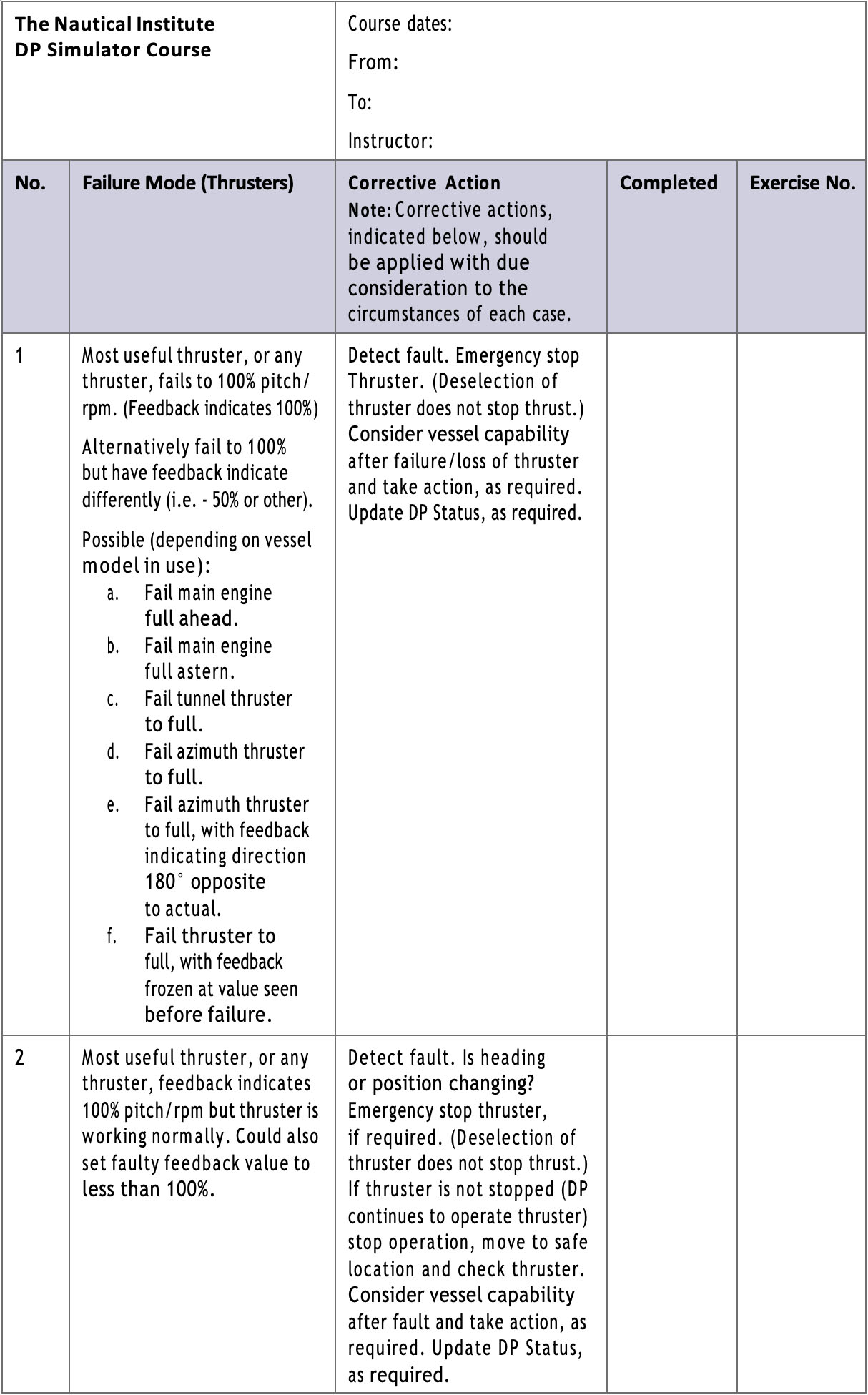
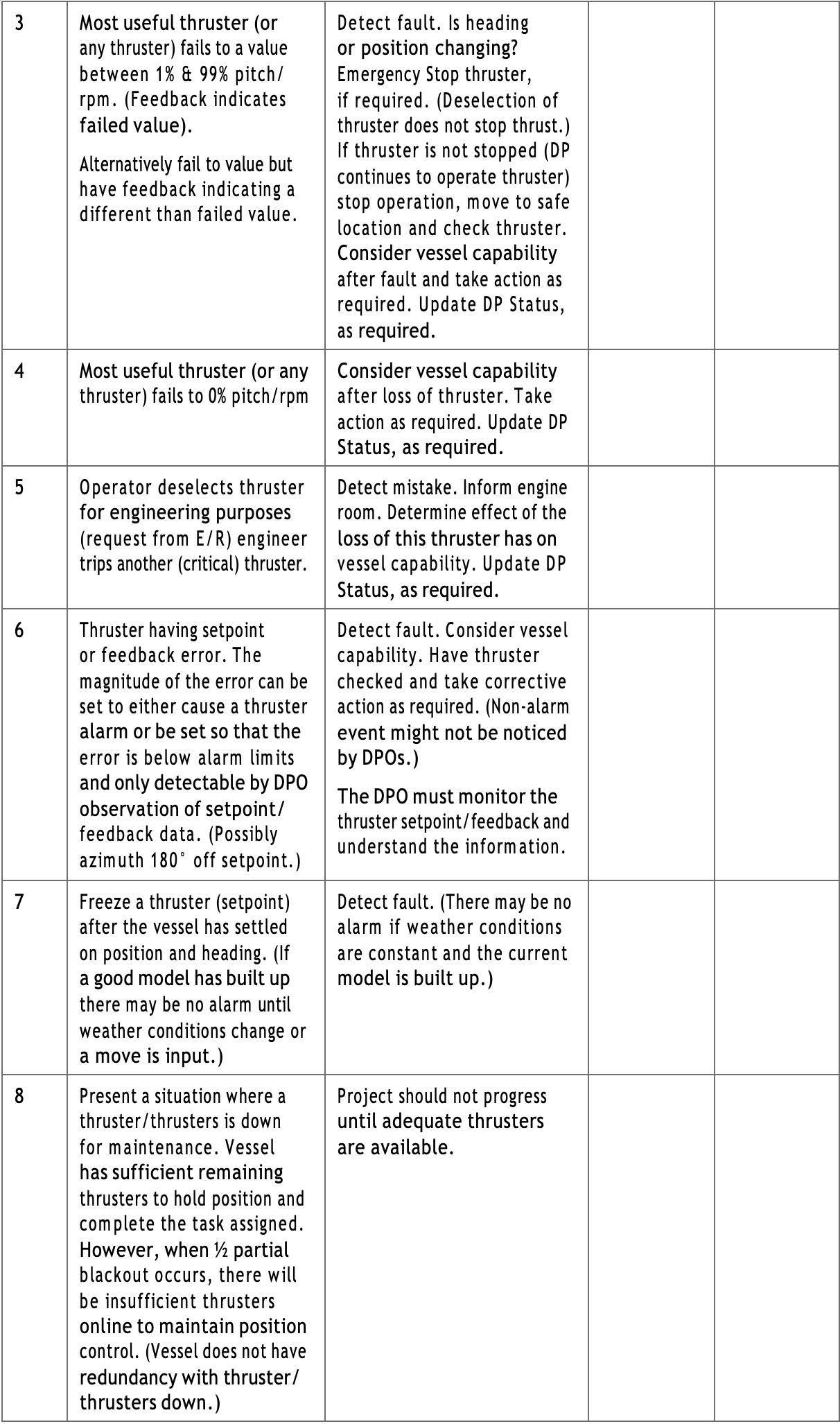
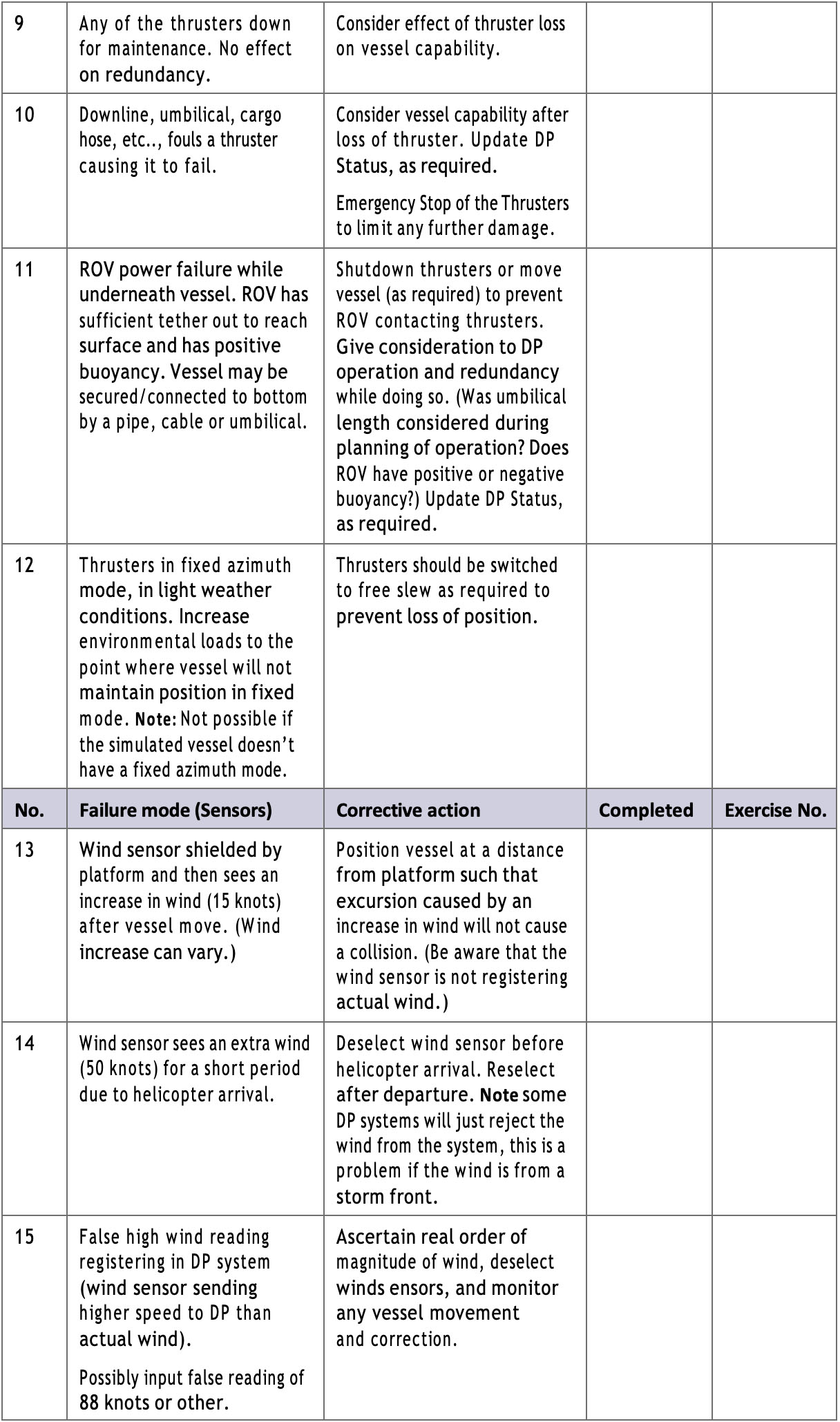
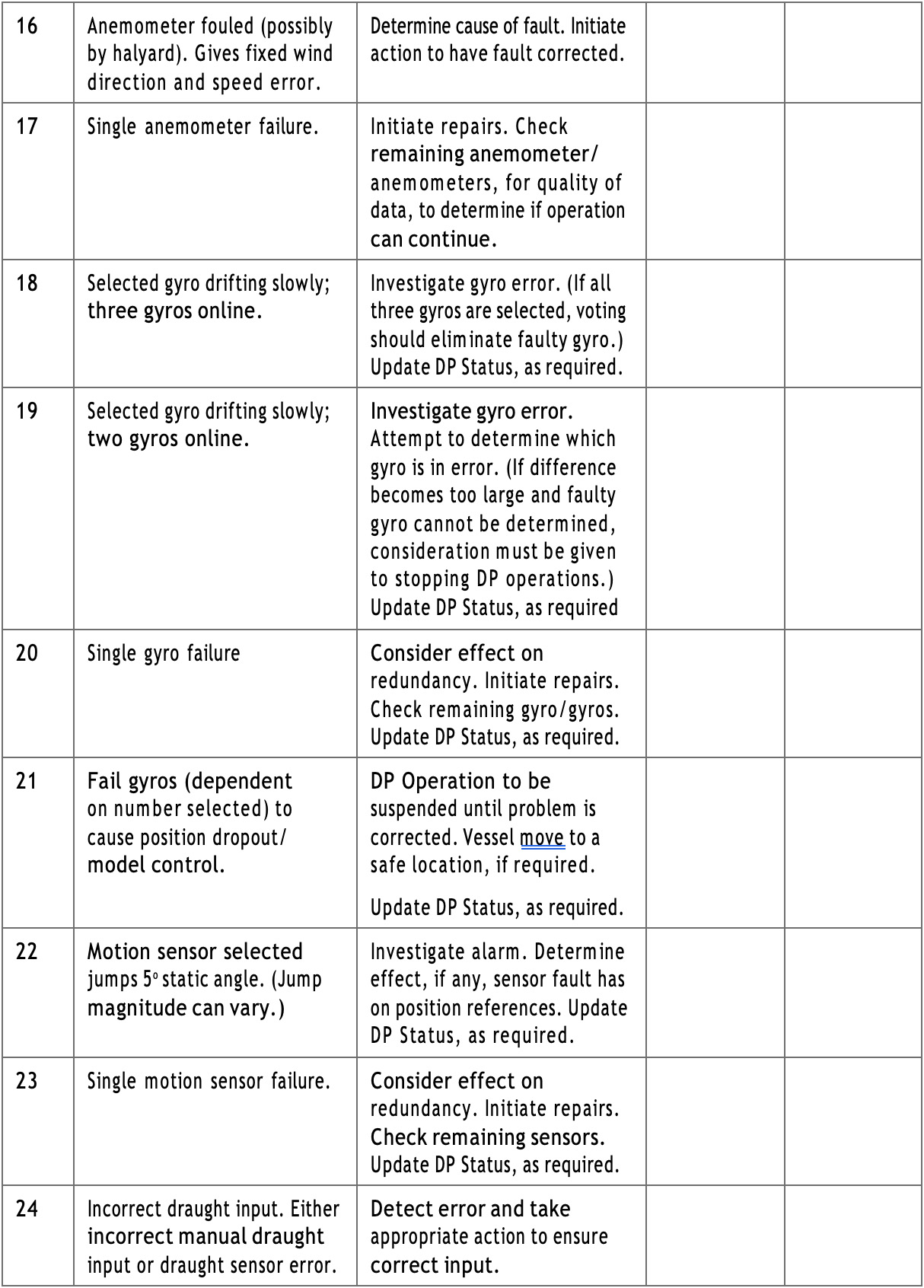
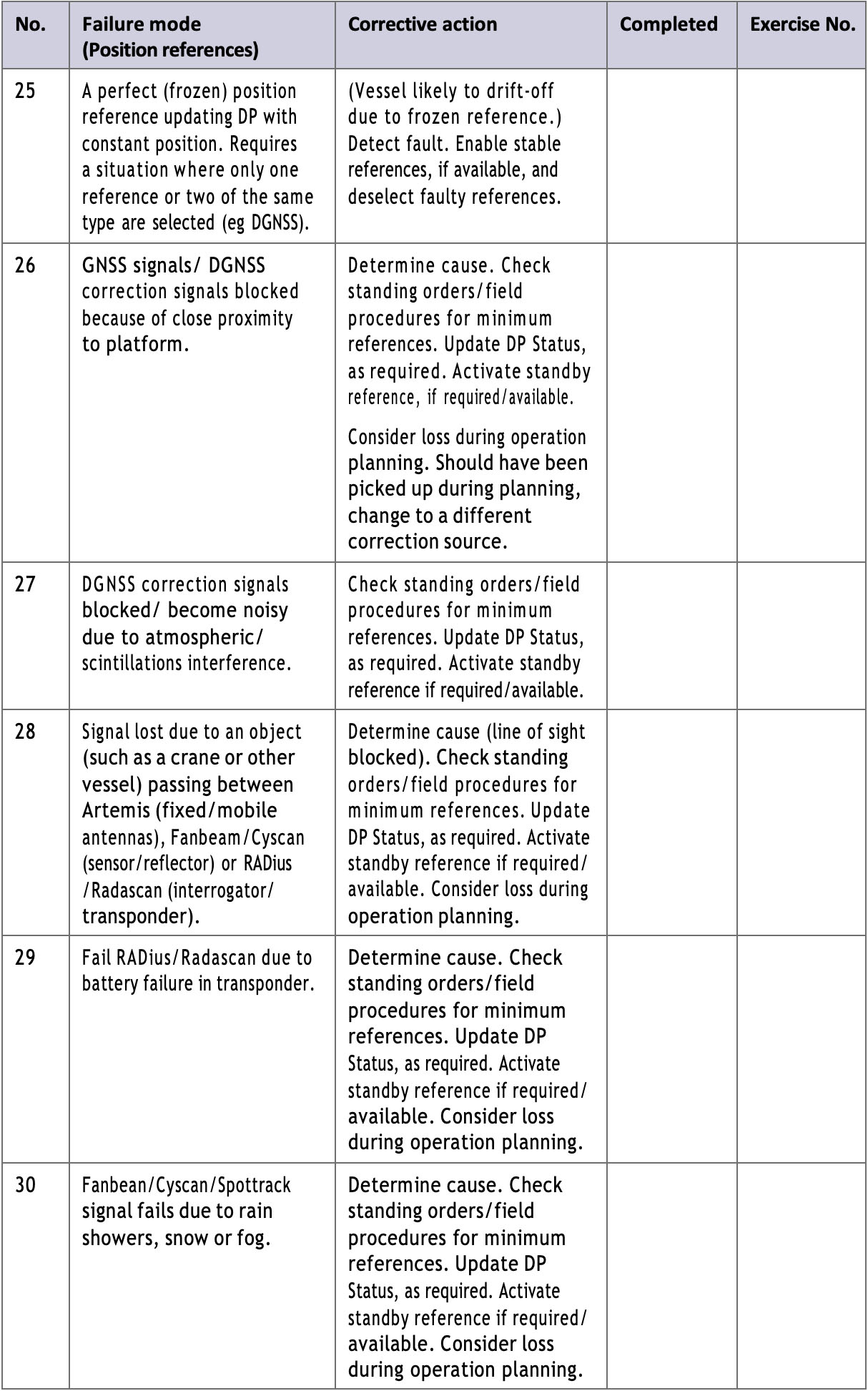
11. Failure Mode Checklist
12. Summary of Simulation
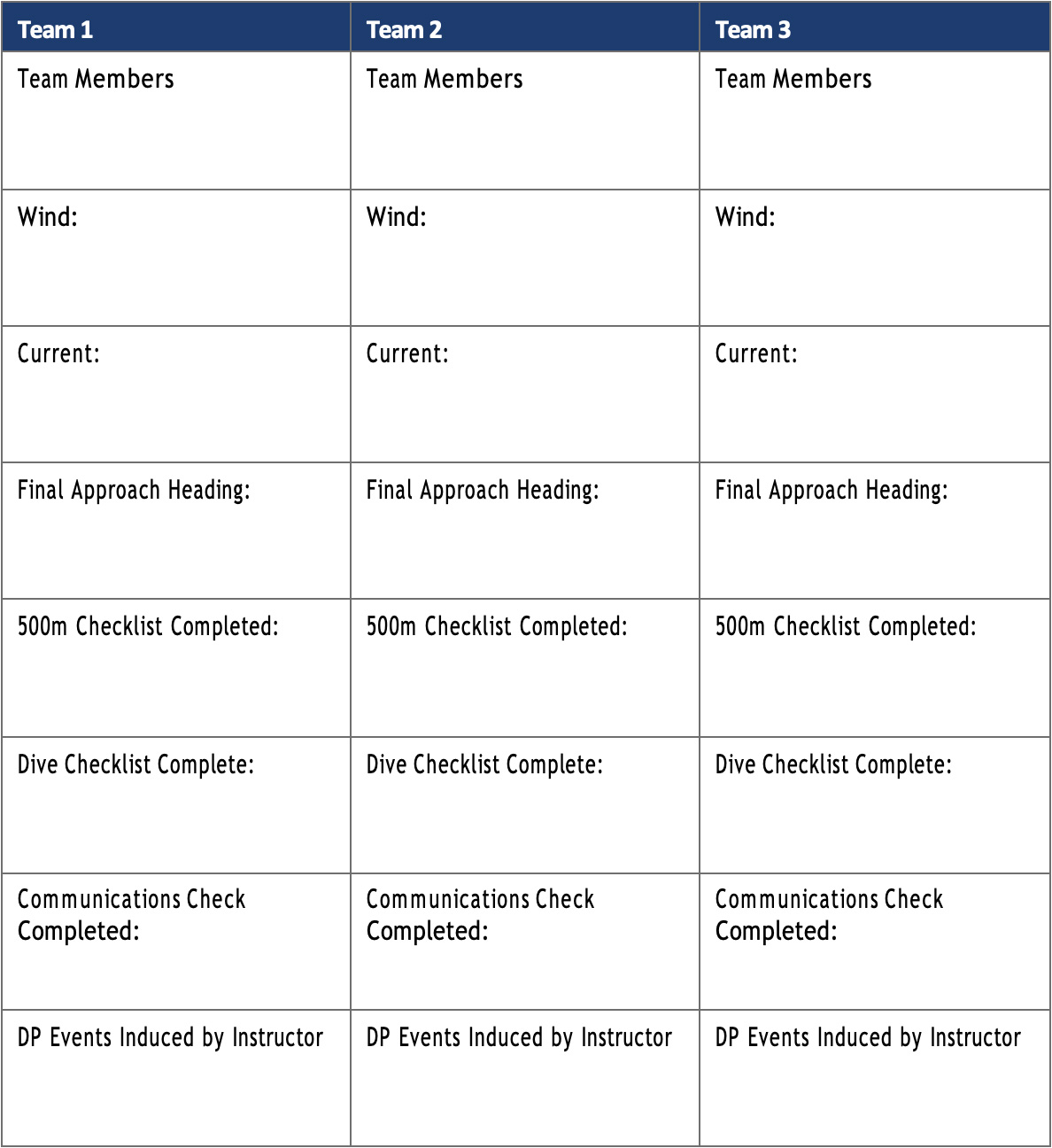
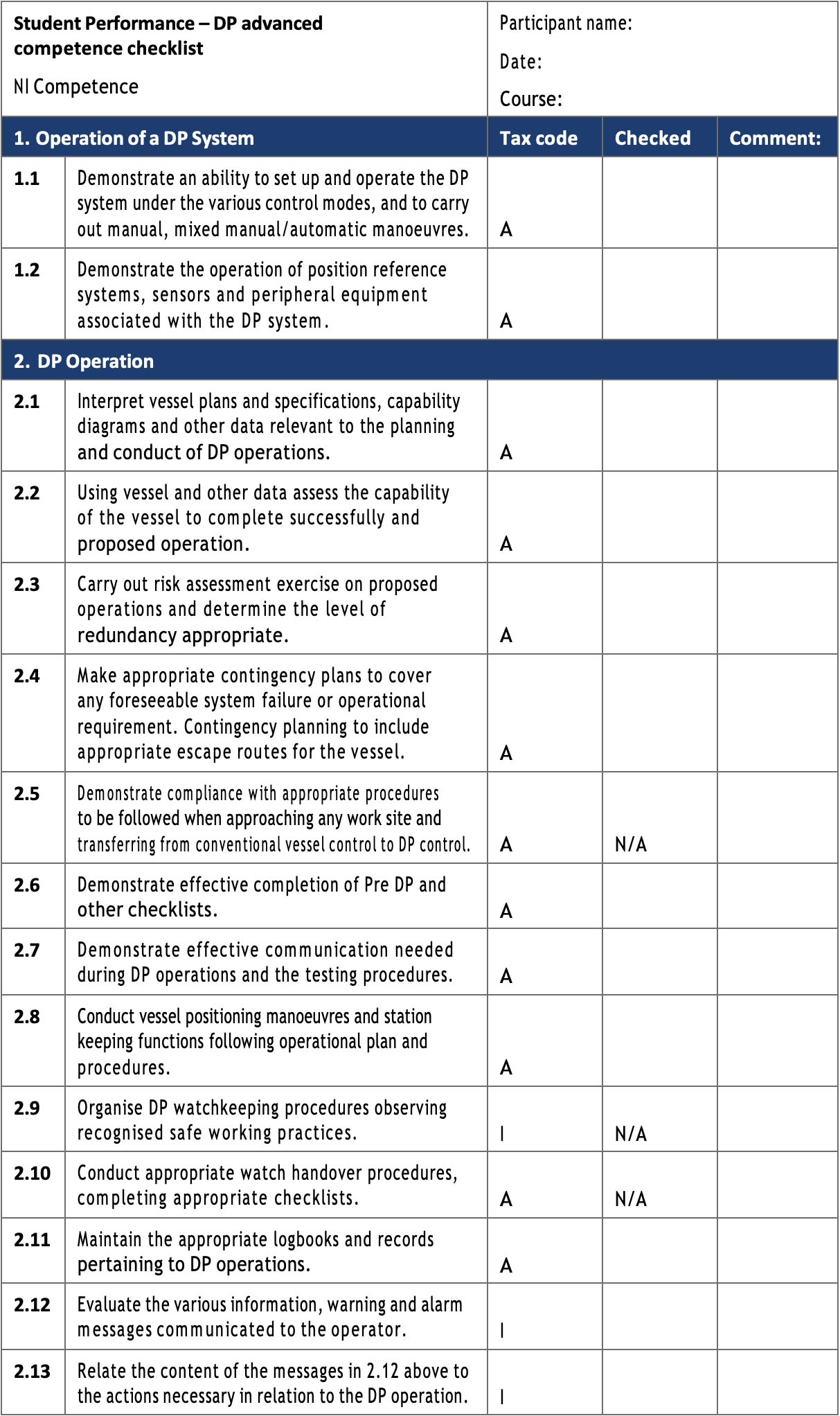
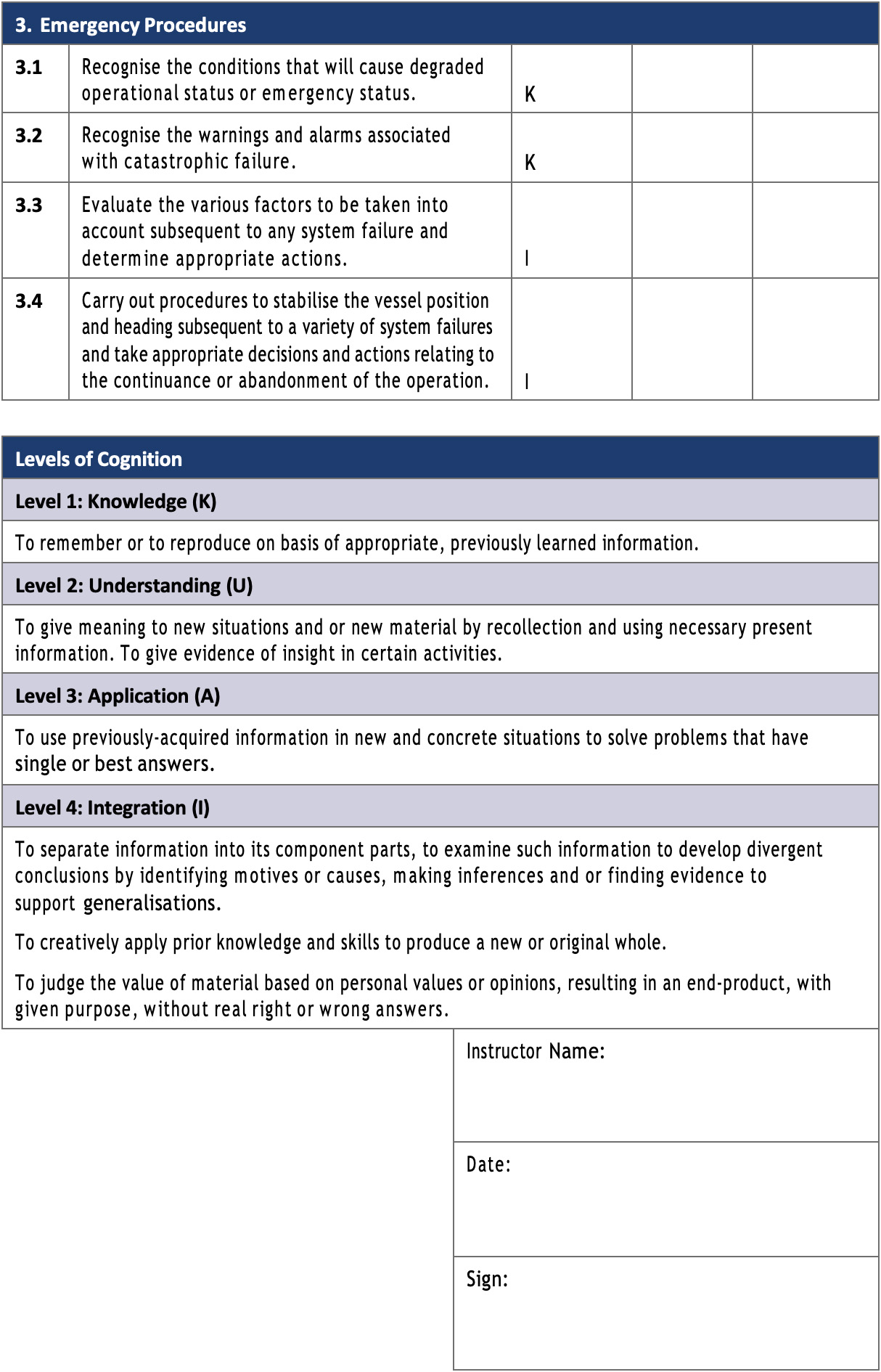
13. Recording Student Performance, Form
14. DP Set-up Practical Assessment Skills Form (Assessor)
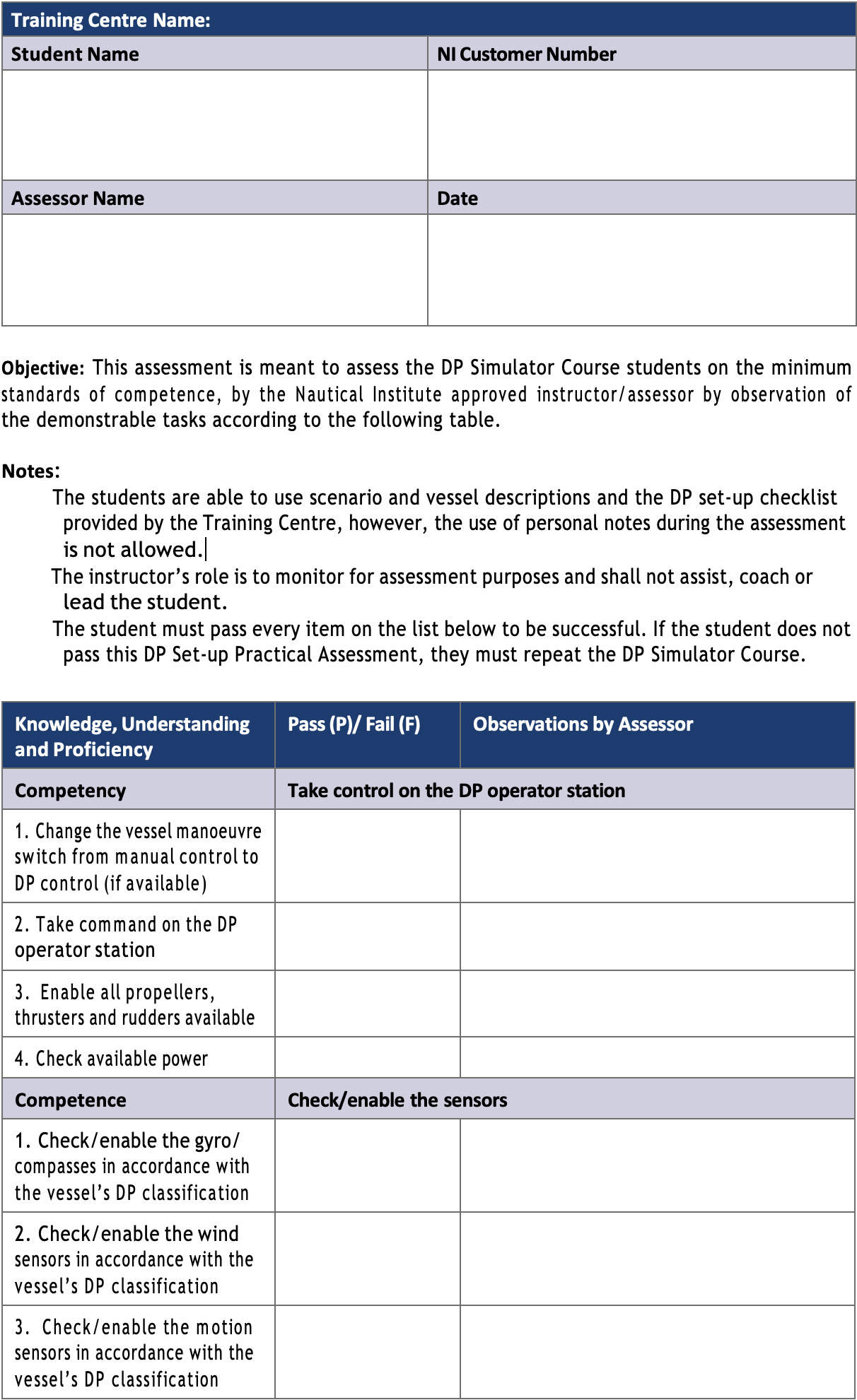
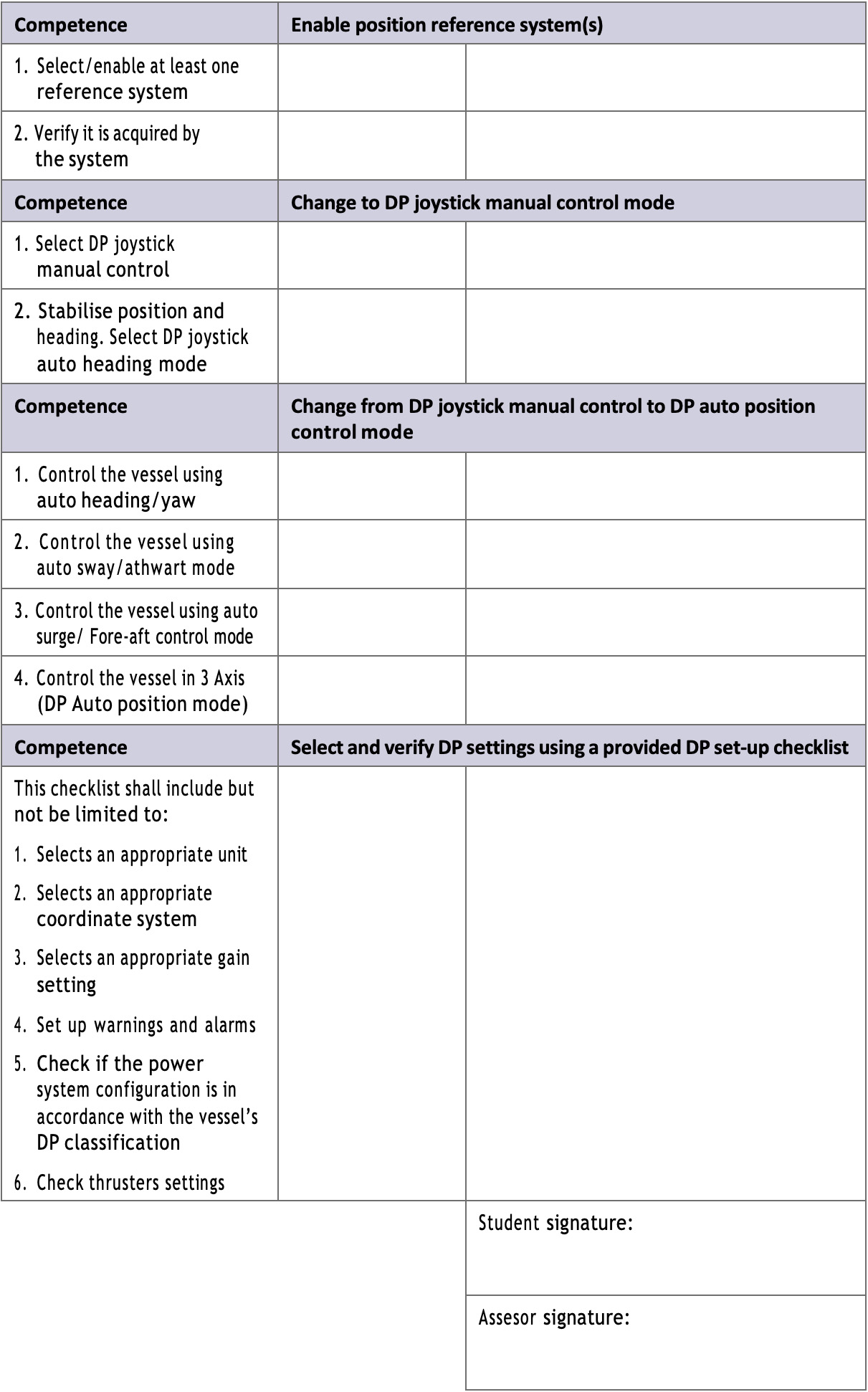
Table of Contents
- 1. Introduction
- 2. Minimum Entry Qualification Requirements
- 3. Number of Hours
- 4. Ratio of Students/Instructors/Equipment
- 5. Delivery Method
- 6. Course Aims
- 7. Course Objectives
- 8. Course Assessment
- 9. Online Assessment
- 10. Practical Assessment
- 11. Failure Mode Checklist
- 12. Summary of Simulation
- 13. Recording Student Performance, Form
- 14. DP Set-up Practical Assessment Skills Form (Assessor)
