
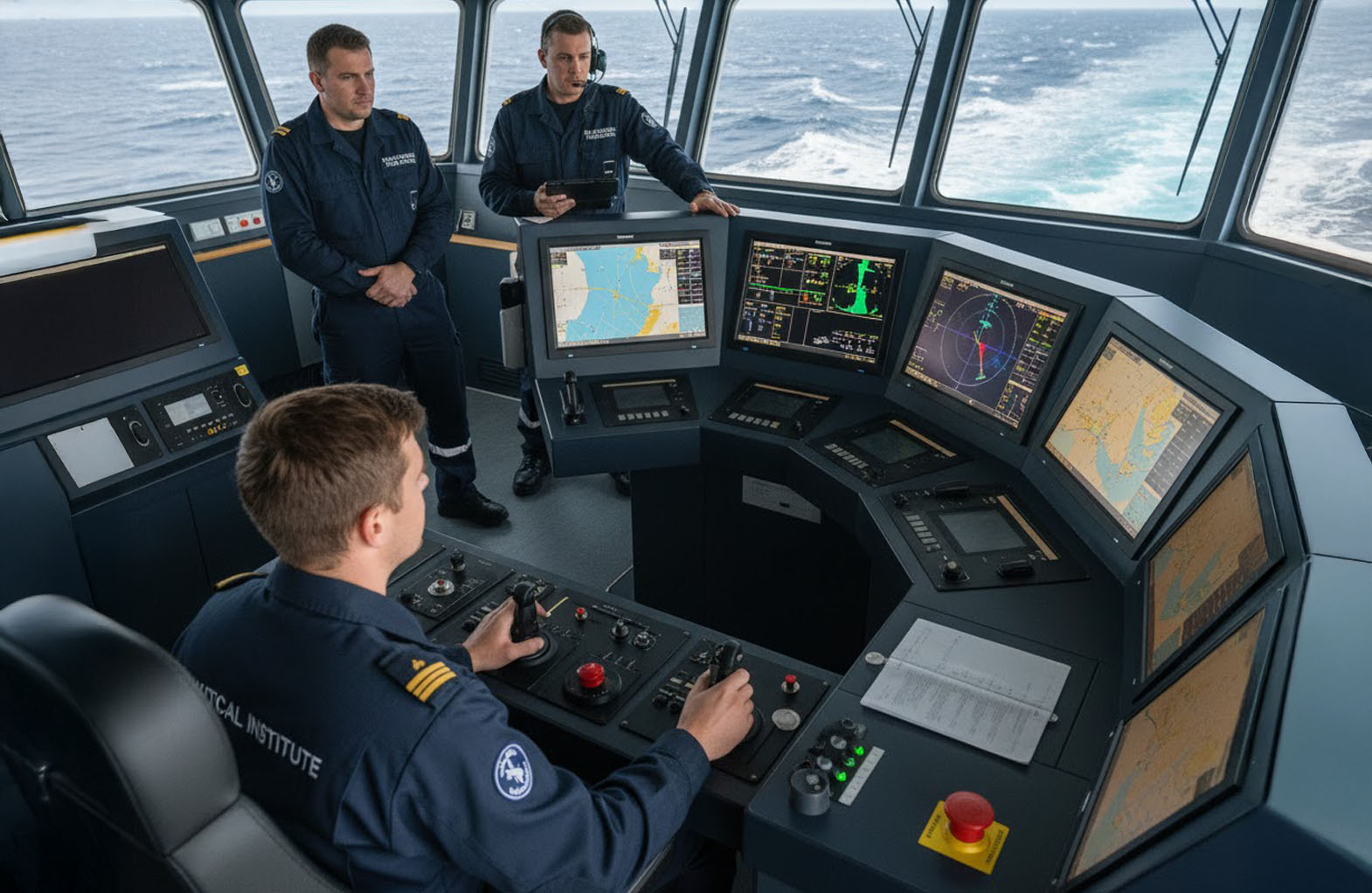
NI Annex H
DP Emergency Shiphandling Course
Instructor
The Nautical Institute
Annex H
DP Emergency Shiphandling Course
February 2025 – Version 1
Disclaimer
While every effort has been made to ensure that all the information in this document is updated and correct, The Nautical Institute cannot be held responsible for any loss, financial or otherwise, direct or indirect, resulting from use of this information. Likewise, The Nautical Institute cannot be held responsible for any damage to property or personnel while following these guidelines. This information is produced in good faith, but The Nautical Institute cannot guarantee the accuracy and/or completeness of the information, which is produced for guidance purposes only.
© The Nautical Institute 2025
200B Lambeth Road, London, SE1 7JY United Kingdom Tel: +44 (0)20 7928 1351
Web: www.nautinst.org | www.nialexisplatform.org
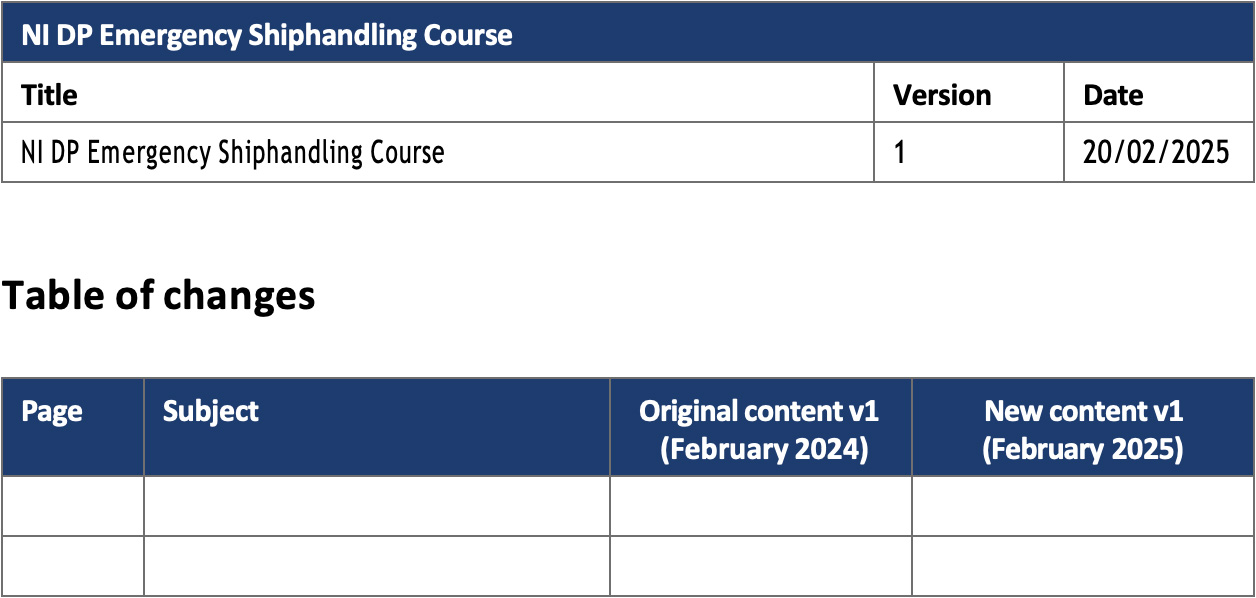
Document version control
1. Introduction
The Nautical Institute (The NI) DP Emergency Shiphandling Course has been designed to provide industry guidance for participants who engage in manual shiphandling activities in vessels operating in Dynamic Positioning mode. The course will enhance the safety of navigation in confined water and in close quarter to oilfield structure to increase the OOW/DPO situation awareness, risk assessment and management under different emergency situations and environmental conditions. It covers the learning objectives, practical assessment, the assessment skills tables and information about continuous assessment.
The expectation is that the participant will have successfully completed a Dynamic Positioning Operator training programme. The course is suitable for DPOs seeking to enhance their skills and suitable for experienced DPOs who may require refreshing their manual shiphandling skills and officers new to offshore vessels
The course will cover shiphandling duties on DP vessels.
The programme involves a course of study with continuous assessment during the course. The overall emphasis of the course is:
- To provide emergency shiphandling training for certificated and prospective
- DP vessel shiphandling knowledge and practical exercises for deck officers and
- To use this course in compliance with onboard competency assessment as per:
- IMCA M117 The training and experience of key DP
- IMCA C002 IMCA Guidance on Competency Assurance and Assessment – Marine
- IMCA C007 Guidance on Assessor
- STCW Table A-II/1.
- To ensure that candidates are prepared for emergency situations in which manual shiphandling techniques are required AND the circumstances in which the change to manual should not be
- The course comprises two parts:
- Classroom – Instruction (Theoretical part maybe conducted on the Navigational Bridge Simulator) to have a ship-like atmosphere and to have descriptive materials at hand, immediate use of material during briefing and debriefing of theory and exercise).
- Simulator – Upon successful completion of the course the participants will be able to demonstrate competence in a number of shiphandling emergency The
participants will be proficient in conning the vessel in different operational situations and loss of equipment.
2. Minimum Entry Qualification Requirements
The minimum entry requirement is that participants should hold a deck Officer Certificate (Officer of the watch (OOW), Chief Mate, Master or Cadet) or DPO qualification.
3. Course Aims
The aims of the course are to give the student the following:
- Confidence to respond appropriately to major failure in the Dynamic Positioning control
- Ability to make the decision when to change to Manual
3.3. An improved understanding of shiphandling in the context of offshore operations.
3.4 Experience of keeping the vessel safe through manual shiphandling skills in a range of conditions.
4. Course Objectives
The course includes conventional and azimuth propulsion simulation, use of thrusters, manoeuvring in sheltered waters and offshore environments including close quarters manoeuvring, holding a vessel in one position after an emergency and operating with reduced machinery capability.
The theory content will revise basic principles of shiphandling including:
- Discussion of wind/current, and their influence on the operation in adverse weather/wind
- Planning of (safe)
- Manoeuvring theory with focus on offshore support
- The effects of displacement, draught, trim, speed, velocity, kinetic energy and under-keel clearance on various manoeuvres, squat effect, turning circles and stopping
- The importance of the pivot point and its effect on shiphandling on vessels that are moving and not
- The effect of current, wind and waves on the vessel’s capabilities when vessel is on different
Specific focus on offshore activities will include:
- The effect and interaction between different type of rudders and propellers, thrusters and their operational advantages and limitations.
- Advantages and disadvantages of different types of
- Contingency planning in case of thruster, rudder and/or propeller
- Contingency operation in the event of a partial
- Correct procedures for changeover between manual, joystick and dynamic positioning manoeuvring
- Effect of a loss of heading when on DP and vessel turning beam on to
- Safe operation in different weather
- Thruster loss at low
- Manoeuvring without bow
- Emergency shiphandling after a worst-case
- Stopping distance when maintaining
- Effect of external forces on a
Documentation Safety
The course will cover critical safety-related aspects including:
- Use of emergency backup
- Holding position in open water and in channels after system
- Thruster emergency
- Alarms associated with propulsion
5. Learning Objectives
The expected learning outcome is that the students will be able to describe or demonstrate the following:
Vessel Machinery Characteristics
- Types of Main Propulsion
- Describe use of the major types of main propulsion systems including:
- Conventional twin/single-
- Azimuthing
- Compare the advantages and disadvantages of the major types of main propulsion
- Utilise the features of various azimuth type propulsion
- Propellers
- Understand the difference between fixed-pitch and controllable pitch propulsion (CPP)
- Compare the advantages and disadvantages of fixed-pitch and controllable pitch
- Azimuthing Bow Thrusters
- Describe the benefits of using azimuthing bow thrusters including their use in pulling power and manoeuvrability when pivot point is on the stern.
- Tunnel Thrusters
- Describe the advantages and disadvantages of tunnel
- Describe the differences between fixed-pitch and controllable pitch tunnel
- Identify how the characteristics of water flow, hull design and speed of the vessel affect the efficiency and effectiveness of a tunnel
- Rudders
- Describe the use of different configurations and types of rudders including: high-lift rudder, fishtail, conventional rudders and split rudders to increase side
- Understand the advantages and disadvantages of each rudder
- Power Management Systems (PMS)
- Describe the functionality of a
- Describe and understand how the PMSs may affect power availability in an emergency shiphandling
Vessel Manoeuvring Characteristics
- Pivot Point of the vessel
- Describe the effect that the use of different thrusters located at different positions on the hull has on the pivot
- Describe the effect that trim has on a vessel’s manoeuvring
- Environmental Forces
- Describe an understanding of the effect that wind, sea and current have on a vessel’s manoeuvring
- Describe an understanding of the forces of wind and current based on the ship’s hull coefficient and wind and current force and relative
- Other Factors
- Describe the ability to manoeuvre a vessel under varying environmental, hydrodynamic and ship pivot point
Vessel Manoeuvring Modes
- Traditional Manoeuvring
- Describe the process of manual shiphandling and station keeping using individual
- Describe proper use of thrusters, rudders and azimuthing propulsion systems to manoeuvre a vessel in varying sea conditions with no defects.
- Describe the use of fixed pitch and CPP azimuth thrusters with and without
- Describe the standard Offshore use of the aft control to berth and
- Heading Control and Joystick Manoeuvring
- Describe changing centre of rotation and power
- Describe advantages of a set
- Describe an understanding of the difference between an Independent joystick and a DP system
- Describe the importance of setting centre rotation to the centre of the
- Describe the correct use of weather and data inputs as these relate to heading
- DP Manoeuvring
- Describe changing rotation centres and power requirements of a DP
- Describe advantages of set heading when using a DP
- Describe the ability to manoeuvre using joystick under varying environmental, hydrodynamic and ship pivot point
Operating Procedures & Risk Assessment
- Operating Procedures & Risk Assessment:
- Describe the importance of procedures and safety guidelines as they apply to offshore marine IMCA, MTS and Guidelines for Offshore Marine Operations (GOMO).
- Describe the importance of industry best-practice in establishing a safe working
- Understand the use of risk assessment processes and the benefits of assessing the risks in mitigating
- Company-Specific Procedures with respect to industry best practices
- Discuss the procedural considerations for operating alongside a
- Describe scenarios when an operation may be
- Define risk assessment and management of change as applied to a company’s
- Describe the ability to apply procedures and risk assessments for a specific
- Describe ASOG, CAM and TAM
Special Manoeuvring Scenarios including Emergency Shiphandling
- Working alongside an installation
- Define the information required before approaching an
- Define the information that may be found on a rig data
- Utilise the information from current and detailed weather reports
- Describe the importance of crane
- Describe the process for setting up for “Drift-on” and “Drift-off” side
- Describe the ability to follow approach and departure
- Describe the effect of changing trim and excessive
- Operating with reduced equipment due to equipment failure
- Describe the effect that a loss of bow thrusters on an azimuth propulsion ship may have on manoeuvrability and station
- Describe the effect that a loss of stern thrusters on conventional twin-screw vessel may have on manoeuvrability and station
- Demonstrate how to manoeuvre using only azimuth thrusters (biasing and non- biasing techniques).
- Describe the use of engines and rudders in the event of thruster
- Describe the ability to overcome equipment failure while maintaining safety of
- Describe actions to be taken after DP failures with the simulator in DP auto mode
6. Number of Hours
The course will be of at least four days’ duration with a minimum of 32 hours’ instruction, with at least 65% of the time assigned to practical shiphandling exercises1.
7. Ratio of Students/Instructors/Equipment
The course will be run in English. The student-to-instructor/simulator ratio will be a maximum of three students to one instructor/simulator.
Course to be conducted at a Nautical Institute accredited Training centre. The instructor must be appropriately qualified and experienced including qualifications as a simulation instructor and relevant seagoing professional qualifications.
The instructor may be assisted by a ship’s Master experienced in offshore vessel shiphandling.
Note: The Nautical Institute will consider submissions for a shorter course with fewer students provided that a minimum of nine hours actual bridge exercise time in control of the ship is assigned to each participant
8. Instructor Qualifications
Instructors must be approved instructors under The NI DPO Scheme.
The instructor/s delivering the course must be approved as an instructor at a NI accredited training centre. They must be able to demonstrate that they possess the adequate shiphandling knowledge that affirms them to be sufficiently competent to deliver the course.
9. Delivery Method
The course will be a blend of learning provided by theory-based instruction with guided practical simulator- based exercises giving a balance of lectures, instruction and practical assessments.
This will be achieved through a concentrated period of exercises on a DP equipped shiphandling simulator, supported by a programme of lectures and instruction. This course may also be delivered, in part, using individual computers for training.
10. Course Assessment
The course will include both a theoretical and practical assessment.
11. Online Assessment
An NI multiple-choice online assessment will be completed by each student at the end of the course. Students who fail at the first attempt are allowed to have another two attempts within six months of the first attempt; however, the second attempt must be undertaken within 96
hours of the first attempt. Failing these three initial attempts, the student is required to repeat the Shiphandling Course and undertake the assessment again.
12. Practical Assessment
Practical assessments will be based on the conduct of each exercise and will determine the candidate’s preparedness for manual shiphandling in emergency situations.
Training centres must develop their own practical exams based upon the course objectives listed above and Course Skills Table below.
The practical assessment must be done individually. As a minimum, the exam must require the student to hold station after a DP emergency (for a specified period of time) and then move the vessel to a safe location under manual control. The time period for holding station will be dependent on the time required to abandon the operation underway at the time of the failure.
The training centre is responsible for ensuring that the assessment is carried out in a professional manner and that the student is assessed with thoroughness in line with the standards of The NI. Candidates
who successfully complete the online examination and practical assessments will receive a completion certificate. Unsuccessful candidates will be advised to seek further training to meet their particular needs.
13. Specific Equipment Requirements
Simulator equipment required to run the course:
- Nautical Institute Shiphandling Simulator OR a simulator that will match the requirement of NI Shiphandling
14. Appendix 1 to DP Emergency Shiphandling – Learning and Proficiency Outcomes
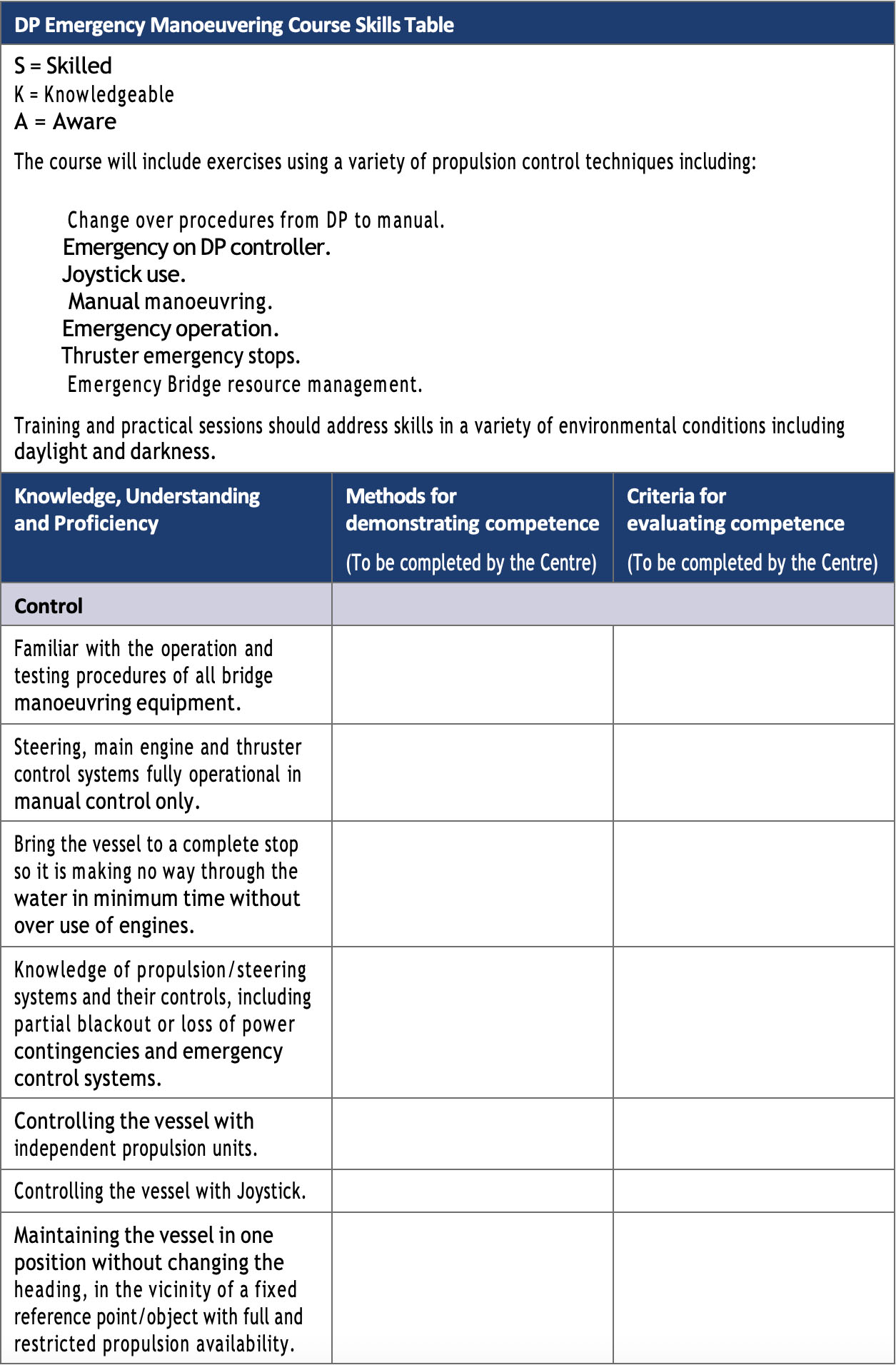
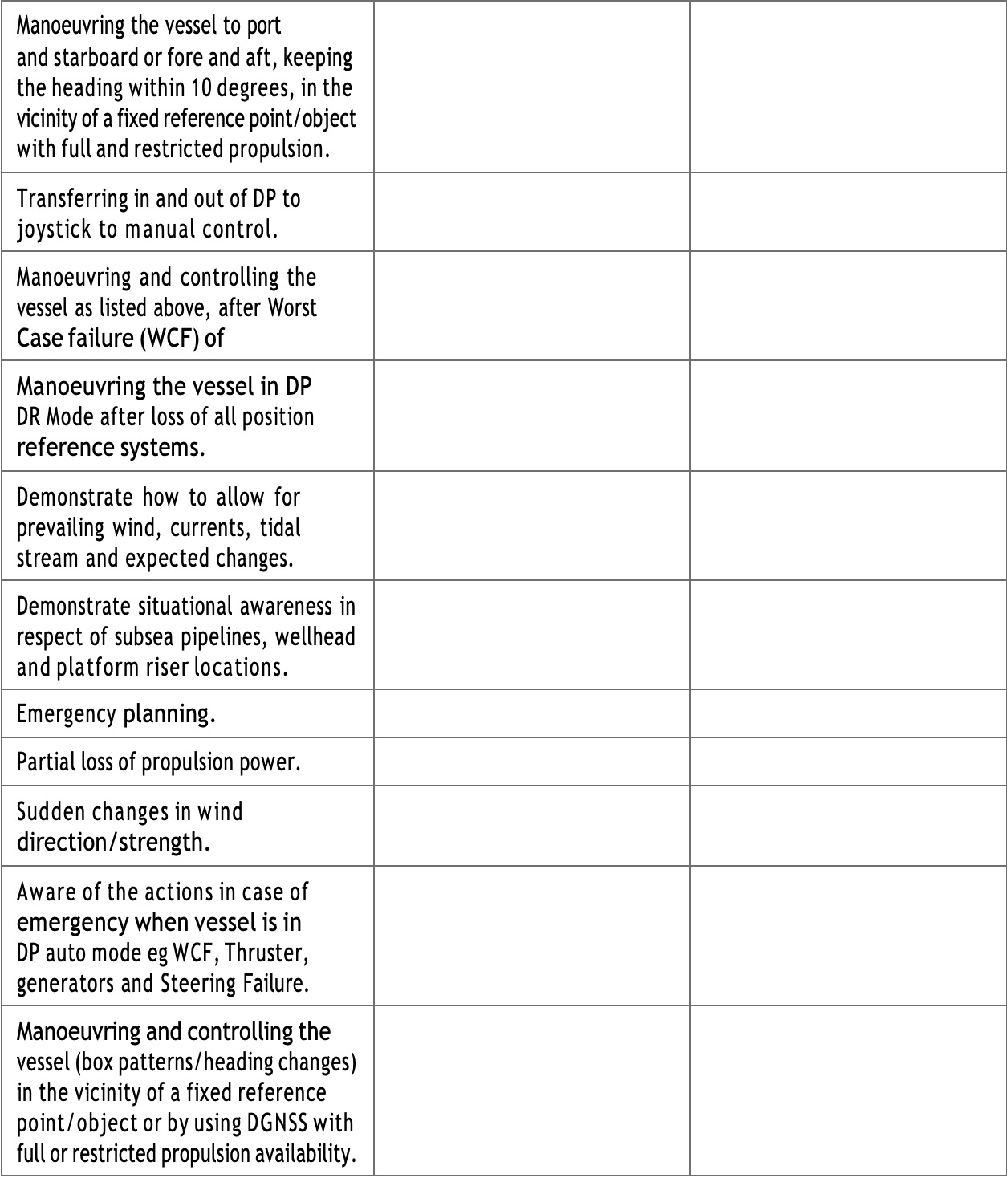
Example Simulator Exercises For Shiphandling
Trainee must be able to:
- Set up a vessel ready for emergency departure from
- Take appropriate initial actions in response to system
- Hold the vessel in the one position and keep the heading within 10 degrees in good and adverse weather/wind condition using only CPP/FPP azimuths and thrusters after a worst case failure. Monitor vessel speed with DGPS or DP screen.
- Move the vessel sideways away from danger only using CPP/FPP azimuths and thrusters after a worst case
- Demonstrate situational awareness both visually and with electronic
- Demonstrate emergency DP Bridge Resource Management
15. Appendix 2 to DP Emergency Shiphandling – Course Structure
The course must be a minimum of 32 hours duration including the assessment periods and must have a minimum of 20 hours assigned to exercises in the simulator.
Note: The Nautical Institute will consider submissions for a shorter course with fewer students provided that a minimum of nine hours actual bridge exercise time in control of the ship is assigned to each participant.
Table of Contents
- 1. Introduction
- 2. Minimum Entry Qualification Requirements
- 3. Course Aims
- 4. Course Objectives
- 5. Learning Objectives
- 6. Number of Hours
- 7. Ratio of Students/Instructors/Equipment
- 8. Instructor Qualifications
- 9. Delivery Method
- 10. Course Assessment
- 11. Online Assessment
- 12. Practical Assessment
- 13. Specific Equipment Requirements
- 14. Appendix 1 to DP Emergency Shiphandling – Learning and Proficiency Outcomes
- 15. Appendix 2 to DP Emergency Shiphandling – Course Structure
