
The NI Annex A
DP Induction Course
Charlie C. Stuart
Instructor
The Nautical Institute
Annex A
DP Induction Course
February 2025 – Version 1
Disclaimer
While every effort has been made to ensure that all the information in this document is updated and correct, The Nautical Institute cannot be held responsible for any loss, financial or otherwise, direct or indirect, resulting from use of this information. Likewise, The Nautical Institute cannot be held responsible for any damage to property or personnel while following these guidelines. This information is produced in good faith, but The Nautical Institute cannot guarantee the accuracy and/or completeness of the information, which is produced for guidance purposes only.
© The Nautical Institute 2025
200B Lambeth Road, London, SE1 7JY United Kingdom Tel: +44 (0)20 7928 1351
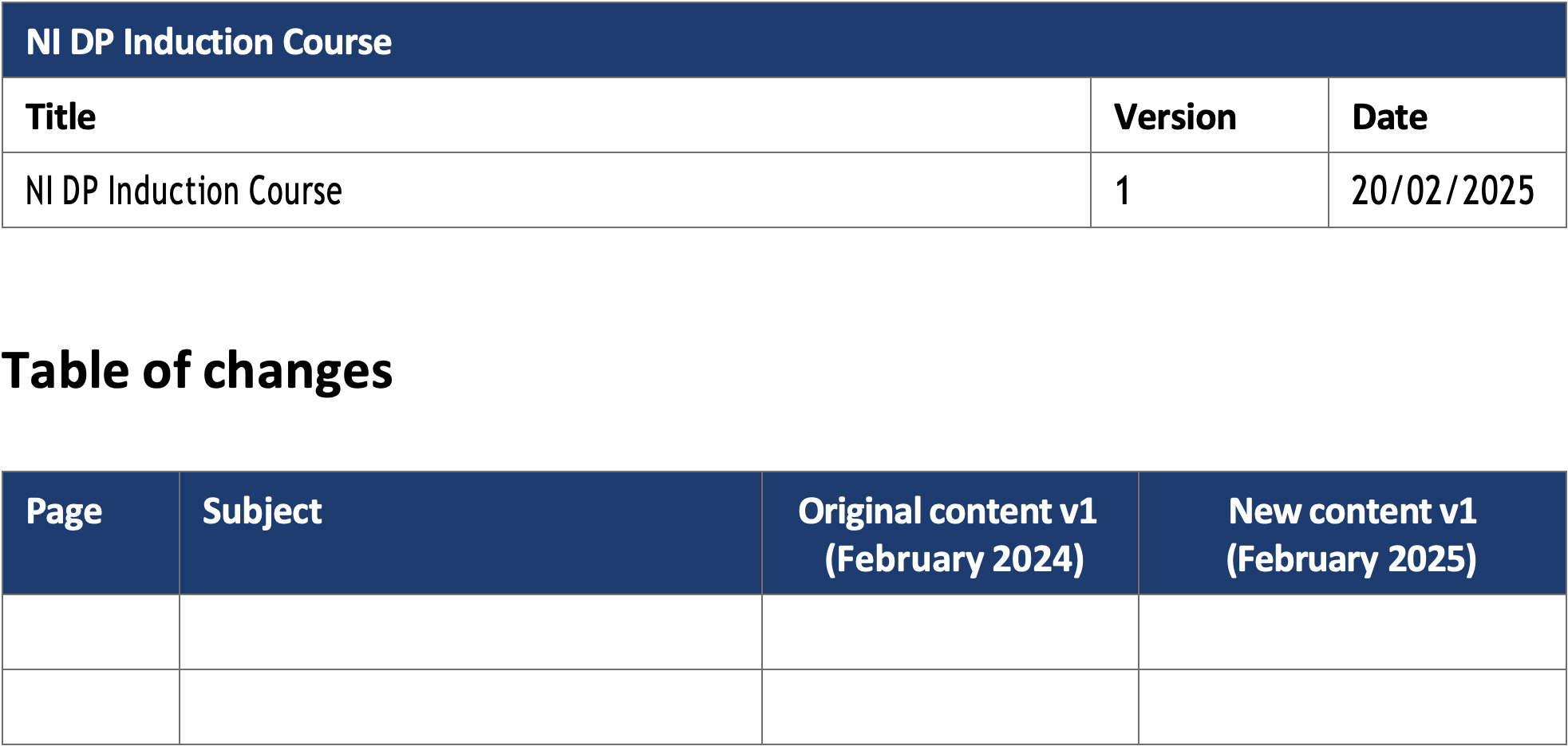
Document version control
1. Introduction
The list of training centres approved for the delivery of these courses may be found on The Nautical Institute’s (The NI) website.
The following courses cannot be taken in consecutive weeks (back-to-back) unless they are being repeated. This is because the DP sea time after each course gives the prospective DPO the opportunity to reinforce, consolidate and put into practice skills learned during the courses.
Induction and Simulator Courses must be undertaken within five years of the date of the application and submission of documents to The NI. In the event that any of these courses fall outside of the five-year period, the trainee will be required to repeat the expired course.
2. Minimum Entry Qualification Requirements
On successful completion of both the Induction Course and induction online exam, the trainee DPO will be issued with a NI DP logbook in which the courses, DP sea time, tasks and the Statement of Suitability are recorded. The subsequent DP sea time following the Induction Course provides the opportunity to complete the task sections in the logbook.
The grey logbook is issued to trainee DPOs that started their training after 1 January 2015. Trainee DPOs who have entered into the training scheme before this date or are repeating the Induction Course shall continue to use their existing logbooks. Trainee DPOs who have transferred to the new offshore scheme will also be issued with a grey logbook.
Trainee DPOs attending an Induction Course after 1 January 2015 will only be permitted to count DP sea time gained after attending the course. Applications received at The NI under the old scheme rules will be evaluated and honoured by the previous regulation.
3. Number of Hours
A minimum of 28 hours teaching time is required for this course; if additional time is required to run exams or deal with paperwork, this time shall be added to the 28 hours. It is expected that 80% of the time is spent on teaching DP theory and 20% on practical exercises. Usually the Induction Course is delivered over four or five days. There is an option to deliver the course over a maximum six-week period, with instruction taking place on a given day in each of those weeks. This option is particularly suited to cadet training institutions as it allows the training to fit into its existing class schedule. In all other aspects the course must conform to all other training scheme standards.
4. Ratio of Students/Instructors/Equipment
The number of students attending the Induction Course must be regulated so that each student obtains sufficient hands-on experience of operating the system to ensure adequate familiarisation with the principles of DP operation. In order to achieve this, The NI allows a maximum of eight students per class being taught by one instructor. If more than eight students are enrolled on the course, a second instructor will be required to assist with practical exercises. In this case, the name and signature of the second instructor should be reflected in the attendance list of the course and practical exercises.
Centres are allowed to seat two students per DP console, which is sufficient to reconcile the availability of equipment and the need to provide sufficient hands-on experience. If this is the case, the ratio for the Induction Course is one instructor to eight students and four DP consoles.
5. Delivery Method
At the start of the Induction Course The NI DP Operator training scheme is to be outlined, including the need to maintain the logbook and the procedure for obtaining a DP Operator Certificate.
The Induction Course is predominantly theory-based with guided practical exercises that introduce the trainee to various DP operational modes. The topics to be covered on the Induction Course are to include:
- General principles of dynamic
- The elements of a DP system:
- Computers and control
- Position reference
- Heading reference
- Wind sensors and other environment reference
- Power generation elements and the
- Thrusters and manoeuvring
- Position reference systems and other sensors; their principles of operation, their use, operational merits and limitations.
- Practical demonstration and operation of a typical DP
- DP vessel operations: hazards associated with certain types of operation, eg shallow water and strong tides.
- Power generation, distribution and
- DP watchkeeping and watch handover procedures, documentation and
The practical element of this course requires the use of a DP system installed in the training centre and delivered with an adequate level of simulation. This equipment must meet the requirements set out in Annex 5 of the Accreditation and Certification Scheme Standard Volume 2. The minimum equipment required for the Induction Course is Class C simulators.
6. Course Aims
At the end of the course the student should:
- Know the principles of
- Have a basic understanding of how to set up a DP
- Have an understanding of the practical operation of associated equipment, including position reference
- Be able to recognise the various alarm, warning and information
- Be able to relate the DP installation to the ship system, including (but not limited to) power supply, manoeuvring facility, available position reference systems and nature of
- Be able to relate DP operations to the existing environmental conditions of wind, sea state, current/tidal stream and vessel movement.
7. Course Objectives
The following is a list of the objectives to be attained by trainee DPOs by successful completion of the Induction Course.
By the completion of the training session or period for the DP control station the trainee should be able to:
- Define Dynamic
- Explain the need for Dynamic Positioning in various types of
- Describe the six freedoms of movement of a
- State which of the six freedoms of movement are controlled under DP and which are
- Describe the following aids to manoeuvring commonly fitted to DP vessels, including their practical and operational advantages and disadvantages: fixed and controllable-pitch propellers, azimuth thrusters, Azipod thrusters and tunnel
- List the seven main components of a DP system; DP operator, DP computer (or controller), DP operator station, position reference systems, sensors, power supply and
- Describe the various modes of DP operation, including manual control, semiautomatic control and automatic In addition, describe the following common specialist functions: ROV follow (follow sub), follow target, track follow (auto track), minimum power (weathervane) and riser angle mode.
- Discuss the concept of mathematical modelling of vessel behaviour characteristics and appreciate the advantages and limitations/disadvantages of this technique.
- Outline the power requirements of a DP vessel system and describe a typical diesel-electric power
- Describe the following position reference systems commonly associated with DP installations: INS, Differential GNSS, hydro acoustic, taut wire, Artemis, FMCW radar and laser-based systems.
- Describe the following sensors associated with DP installations: vertical reference sensor/unit, motion reference unit, gyrocompass, wind sensor (anemometer) and manual draught input
- Describe the concept of centre of rotation and the provision of alternative centres of
- Describe consequence analysis as carried out by a Dynamic Positioning
By the completion of the training session or period, for the power generation and management the trainee should be able to:
- Describe the power generation and distribution arrangements in a typical diesel-electric DP vessel, with particular reference to system redundancy as described in IMO MSC 645, 1580 and vessel FMEA.
- Describe the power supply and distribution arrangements in a typical hybrid diesel/diesel- electric DP (Main CPP or direct-drive azimuth thrusters)
- Recognise the power requirements of DP vessels and explain the concept of available power and spinning reserve in worst case failure.
- Describe the functions of a power management system as installed on Class 2 and Class 3 DP
- Describe the provision of uninterruptible power supply to the DP system, with particular reference to power shortages, failures and system redundancy.
By the completion of the training session or period for the propulsion units the trainee should be able to:
- Describe the following types of propulsion system commonly installed in DP equipped vessels: for example, main propellers and rudders, azimuth thrusters, Azipod thrusters and tunnel thrusters, waterjet and Voith Schnieder
- Describe the importance of monitoring the displayed values of setpoint and feedback data for thruster and propeller rpm, pitch and/or
- Describe the operational characteristics and common failure modes of the different types of propulsion systems as described in 19
By the completion of the training session or period for the position reference systems (PRS) the trainee should be able to:
- Describe the operation of hydroacoustic position reference (HPR)
- Describe the principles of position-fixing using underwater acoustic systems working in SSBL/ USBL, LBL and SBL
- Describe the various types of hydroacoustic beacon: transponder, responder and pinger/beacon.
- Describe the layout of a typical hydroacoustic system including operator station, transceiver, transducer pole and
- List the operational advantages and limitations of acoustic systems as a position reference for
- Describe the principle and operation of the Artemis position reference
- List the operational advantages and limitations of the Artemis position reference
- List the different types of taut wire position reference system: vertical lightweight, vertical deep water, vertical moon pool, horizontal and horizontal gangway.
- Describe the display of taut wire reference data in the DP
- Describe the principle of position reference using the taut wire
- List the advantages and limitations of the taut wire position reference
- Describe the principles of the Differential GNSS (DGNSS)
- Outline the operation of a typical commercial DGNSS network where corrections are delivered by satellite communications.
- List the sources of error and inaccuracy associated with the DGNSS system, describing the effects on the quality of
- List the available quality data associated with the DGNSS
- List the advantages and limitations of the DGNSS system when compared with other
- Describe the principles used in relative DGNSS
- Describe the principles of position reference using laser-based
- Outline the method of setting up a laser system to provide best position
- List the advantages and limitations associated with a laser-based
- Describe the principles of position reference using FMCW radar-based
- List the advantages and limitations associated with FMCW radar-based
- Describe the principle of Inertial Navigation Systems (INS) and the methods of using INS to enhance existing PRS
- Discuss the relative accuracy and reliability of PRS, together with the methods used to apply weighting and pooling and voting when more than one PRS is Median rejection of PRS when three or more are used and the importance of monitoring the position reference page.
- Describe other PRS that may be used in conjunction with a DP
By the completion of the training session or period for the heading and motion reference systems the trainee should be able to:
- Describe the function of gyro compasses and their redundancy within a DP
- Describe how to obtain pitch, roll and heave information for input into a DP
- Describe the reason for inputting pitch, roll and heave into a DP
By the completion of the training session or period for the environmental reference systems the trainee should be able to:
- Describe the provision of wind sensors within the DP
- Describe the wind feed-forward facility and its importance within the DP
- Recognise the limitations of wind sensor Explain the reasons for and the consequences of deselecting wind sensor inputs.
- Describe the method by which the DP system determines the value for DP current or Sea Force (the residual error resulting from unmeasured errors & unmeasured forces acting on the vessel).
- List the reasons for discrepancy between the displayed value of DP current (or Sea Force) on the DP system and the true current or tidal stream
By the completion of the training session or period for the external force reference systems the trainee should be able to:
- Describe the use of external force reference systems such as hawser tension, plough cable tension and pipe tension
By the completion of the training session or period for the DP operations the trainee should be able to:
- Describe the procedures to be followed when approaching a worksite and transferring from conventional navigation to DP
- Discuss the need for completing pre-DP and other checklists prior to and during DP
- Explain the need for keeping logbook records of all DP operations, failures and
- Explain the need for keeping records of operation, maintenance and repairs of DP and ancillary
- Describe the need for effective communications during the conduct of DP
- Outline the procedures to be followed by the DPO when taking over the control of the vessel’s positioning and
- Describe the structure of alarm/warning and information messages provided on the DP system displays and on the DP
- Recognise the alarms/warnings associated with loss of redundancy after worst case failure and the possible loss of heading or position if another failure occurs after a worst case failure (part loss of some thrusters and power) and catastrophic failure (loss of heading and/or position control). ASOG, TAM and
- Outline the navigational projections, spheroids and datums that may be used in operations involving Dynamic
- Explain the use of worksite diagrams using Universal Transverse Mercator (UTM)
- Explain the need for planning DP operations, including emergency and contingency situations ASOG, TAM and
- List the various following providers of documents containing statutory requirements and guidance relating to DP operations, including:
- MO (including IMO MSC/Circ. 645 of 1994 and 1580 of 2017 Guidelines for Vessels with Dynamic Positioning Systems).
- Classification society DP rules (example from classification society which is member of IACS)
- International Marine Contractors Association (IMCA).
- Marine Technology Society (MTS).
Explain the purpose of documentation associated with DP operations, such as DP operations manuals, Failure Modes and Effects Analysis (FMEA) and capability plots. ASOG, TAM and CAM. Describe the IMO (DP) equipment classes and their application, with reference to the IMO Guidelines for Vessels with DP Systems. Understand that classification societies use either numbers (eg ABS DPS-2) or letters {eg Lloyd’s Register DP (AA) to denote the DP Class allocated to the vessel. Describe in outline the DP operations conducted by the following vessel types:
- Diving and underwater support
- Drilling ships and semi-
- Cable lay and repair
- Pipelay
- Rock dumping and dredging
- Shuttle tanker and FPSO/FSO
- Flotel (accommodation)
- Crane barges and construction
- Anchor-handling and platform supply
- Cruise ships and luxury
- State and describe the hazards associated with DP operations conducted in areas of shallow water and/or strong tidal conditions.
- Describe the hazards associated with DP operations in very deep
By the completion of the training session or period for the practical operation of a DP system the trainee should be able to:
- Demonstrate the use of the joystick to manoeuvre the vessel and bring the vessel to a stop in a seamanlike
- Demonstrate the correct procedure for setting up the DP system in both manual and automatic
- Demonstrate position and heading change manoeuvres, using both automatic and manual DP
- Demonstrate the use of commonly provided functions on the DP control As a minimum, including Gain, Fixed Azimuth mode and Thruster bias.
- Demonstrate the use of common modes found on a DP system, as a minimum Track Follow, Minimum Power and ROV
8. Course Assessment
Not Applicable
9. Online Assessment
In order to be awarded a certificate of completion for the Induction Course the trainee must pass an online assessment at the training centre. The exam is composed of multiple choice questions and shall be completed in 1 hour 15 minutes. The online assessment will consist of 40 questions and shall be completed with a pass mark of 70%.
Students who fail at the first attempt are allowed to have another two attempts within six months of the first attempt; however, the second attempt must be undertaken within 96 hours of the first attempt. Failing these three initial attempts, the student is required to repeat the Induction Course and undertake the assessment again.
On successful completion of the Induction Course and online assessment, the trainee Dynamic Positioning Operator will be issued with a Nautical Institute Dynamic Positioning Operator’s logbook in which their courses, DP sea time, task completion and Statement of Suitability as a DPO are recorded.
10. Practical Assessment
Not applicable
11. Blended Learning for Induction Course Only
Definitions:
CBT: Computer-based training; a computer course that completely replaces face-to-face training.
Blended learning: a methodology that combines CBT with face-to-face and/or practical training.
CBT courses are not recommended for DP courses because the trainee DPO must learn skills that cannot be taught via computer only, including communication, delegation and emergency response. Trainee DP Operators learn from each other during a face-to-face course as they participate in discussions and debrief after exercises.
Blended learning can be accepted as a delivery method for the DP Induction Course only, not the Simulator Course. CBT may be used to deliver the theoretical portion of the Induction Course after which a minimum of two and a half days will be required in a traditional class. At least two full days should be used for exercises, not theory, and a half day should be used to administer the external online assessment.
The course must comply with the aims and objectives and shall be assessed by The NI on a case- by-case basis.
During the CBT portion of the course, computer assessments for each unit of material covered will be administered to verify that the trainee understands that material. The pass mark will be 70% for these interim assessments. Once the CBT is complete, the training centre shall administer a further assessment to ensure that the trainee is ready for the practical portion of the course and is at a level of understanding aligned with other trainees in the class.
One instructor should be allocated to support each student and support should be given seven days a week and cover all parts of the world.
Training centres are entitled to set appropriate limits on the time that trainees may allow to elapse between the remote and classroom portions of their training, if they wish. However, these must be aligned with their own terms of reference and be set with fair consideration for the professional restrictions of seafaring DPOs.
12. Online Induction Course (Theory Part)
The NI DP Induction Course comprises 80% of theory and 20% practical training.
The training centres that wish to deliver the induction course’s online theory, must seek and receive approval from The Nautical Institute.
Documentation to submit to The Nautical Institute for approval:
- Details of the instructors to be used for online
- Timetable for online course delivery and practical training at the training
- Details of how learning materials will be provided to the
- Details of the delivery methodology, including online learning
- Details of the required equipment needed by the trainee DPO at the remote
- Confirmation of the arrangements for the training and assessment before commencement of practical training of Induction course at the training
The trainee DPO must return to the training centre within three months after completion of the online theory lessons to complete the induction course in its entirety. The course certificate and logbook should be handed to the candidate upon completing the course and passing an online exam.
The NI will not accept any sea-time until the candidate completes the induction course theory, practical and online exam.
The Nautical Institute reserves the right to review the online course delivery from time to time. If the online course delivery is found to be sub-standard, The NI will revoke the approval.
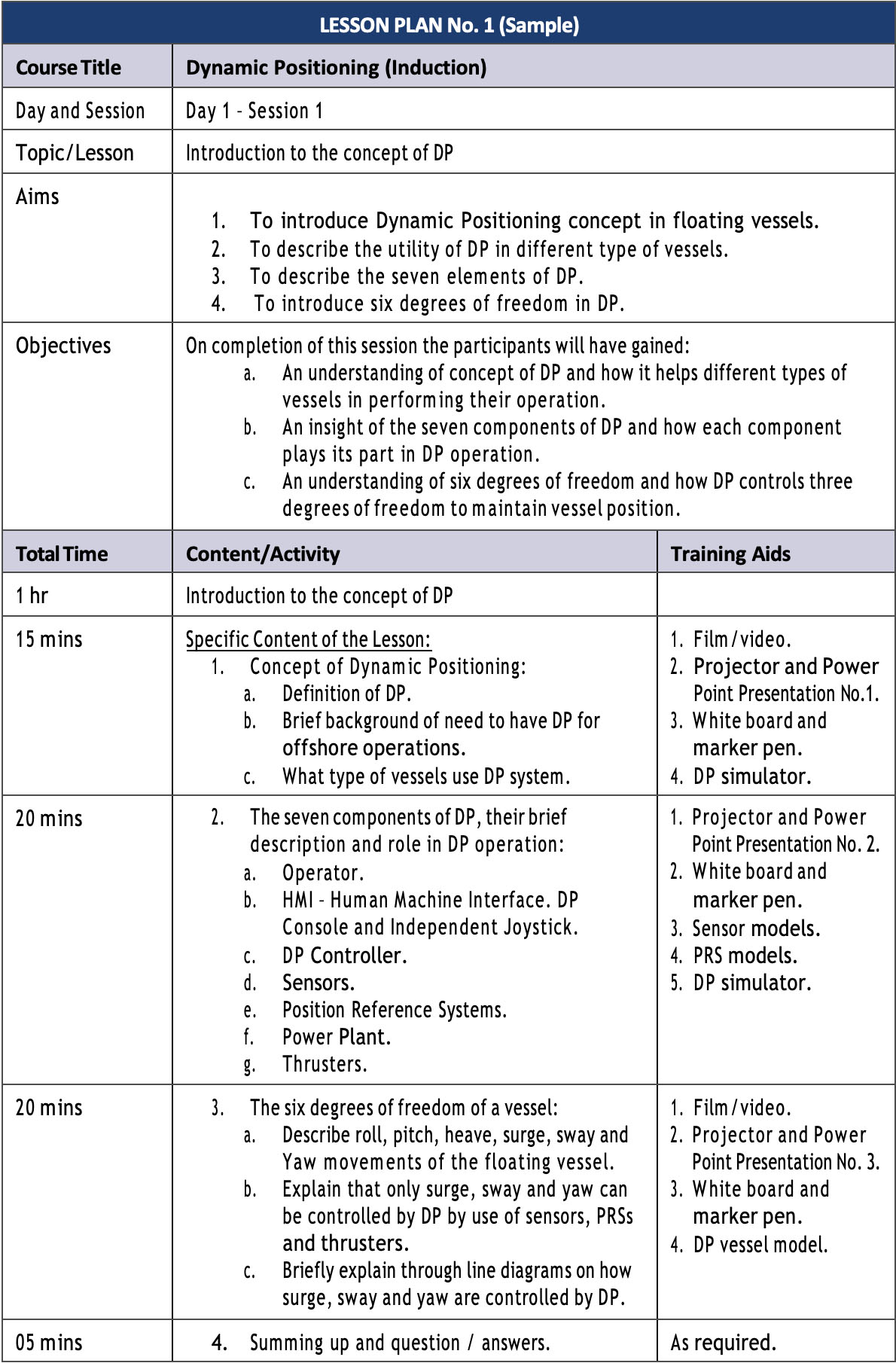
Table of Contents
- 1. Introduction
- 2. Minimum Entry Qualification Requirements
- 3. Number of Hours
- 4. Ratio of Students/Instructors/Equipment
- 5. Delivery Method
- 6. Course Aims
- 7. Course Objectives
- 8. Course Assessment
- 9. Online Assessment
- 10. Practical Assessment
- 11. Blended Learning for Induction Course Only
- 12. Online Induction Course (Theory Part)
